Teacher Tribe SVG
A Designer’s First Glance: Friendly, Focused, and Ready for Real Threads
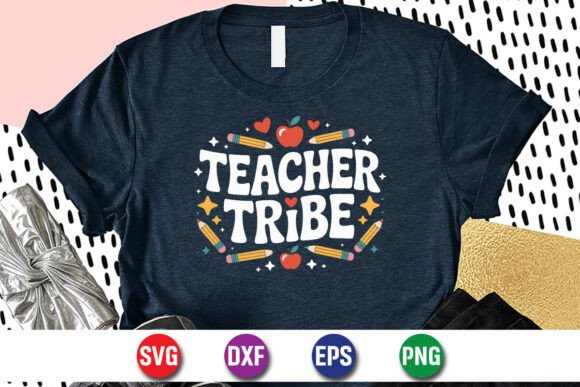
Opening Teacher Tribe SVG feels like stepping into a staff lounge on the first day of school—warm, grounded, and quietly confident. It’s not flashy or overdesigned; it leans into clean typography with subtle personality—rounded letterforms, gentle spacing, and a rhythm that reads easily at a glance. As a machine embroidery design, its strength lies in restraint: no excessive flourishes, no fragile serifs, no micro-details that’ll vanish under satin stitch. That makes it instantly promising for custom apparel, embroidered patches, and small shop merchandise where clarity and wearability matter more than complexity.
How It Lands on Actual Embroidered Products
Last week, I prepped a batch of organic cotton tote bags for a local teacher appreciation pop-up—simple canvas, medium-weight, lightly textured. I digitized Teacher Tribe SVG as a 3.5" wide chest placement, using a balanced mix of satin stitch for outlines and soft fill stitch for interior letters. The result? Crisp legibility, even from across the room. Teachers paused, smiled, pointed—and several said, “That’s *us*.” That kind of quiet resonance is rare in T-Shirt Designs, especially ones meant for real-world use. It worked just as well on midweight sweatshirts (with tear-away + cutaway stabilizer) and on tea towels (where I reduced density slightly to avoid stiffness).
I also tested it on a baby onesie—scaled down to 2.25"—and found the letter spacing held up cleanly. No crowding. No thread nesting in corners. That’s a strong signal this isn’t just a graphics file for screen printing; it translates thoughtfully to embroidery project constraints. For Etsy sellers or craft fair vendors, that versatility means one design can support multiple product lines: tote bag design, sweatshirt embroidery, holiday embroidery (think “Teacher Tribe” on a mug cozy or pillow cover), and even embroidered patches for lanyards or backpacks.
Where Caution Is Built In—Not Added Later
Teacher Tribe SVG doesn’t pretend to be everything to everyone. And that’s its quiet professionalism. It’s not ideal for ultra-small hoop sizes (<2") without careful simplification—those rounded terminals need breathing room. On highly textured fabrics like bouclé or thick terry cloth, I’d suggest lightening fill stitch density or switching to a running stitch outline with minimal fill to preserve definition. And while it handles dark fabric beautifully (especially in cream or gold thread), avoid pairing it with low-contrast thread colors on black or navy unless you’re aiming for subtle branding—not statement.
Curved surfaces like caps require slight letter-spacing adjustment and a smaller overall width—I’d cap it at 3" for front-panel placement. Also, skip it on ultra-thin knits (like lightweight rayon blends) without proper cutaway stabilizer underneath; the design’s moderate stitch density needs support to prevent puckering. These aren’t flaws—they’re built-in cues telling you exactly where and how to apply it well.
What It Adds to Your Finished Product—Beyond the Stitch
When customers see Teacher Tribe SVG on a handmade product, they don’t just read words—they recognize belonging. That shifts perception: a $28 embroidered tote becomes a meaningful personalized gift. A $42 sweatshirt reads less like apparel, more like insider recognition. For boutique branding or small shop product lines, it supports consistency without demanding rigid templates—it fits naturally beside chalkboard-style icons, apple motifs, or minimalist quote designs.
It also builds trust. Because the design avoids clip-art energy and doesn’t rely on trend-chasing fonts or forced whimsy, it signals care—not just in execution, but in intention. Buyers sense that. Especially educators, who spot inauthenticity fast. That authenticity lifts perceived value, encourages repeat orders, and makes your craft business feel human-centered, not algorithm-optimized.
Practical Notes Every Embroidery Designer Should Run Through
- Always test on scrap fabric first—especially if stitching on stretchy fabric or layered garments like hoodies.
- Check thread color contrast in natural light *and* under store lighting—cream on oatmeal looks different than on heather gray.
- Review stitch density before scaling: higher density works on stable fabrics, but may overwhelm delicate textiles like baby embroidery or holiday embroidery on linen napkins.
- Confirm hoop size compatibility—if your machine maxes out at 4"x4", verify the full design fits comfortably with seam allowance buffer.
- Inspect small details at actual stitch-out size: are inner curves smooth? Do letters like “e” or “a” retain openness?
- Test in black-and-white mockups—this reveals balance and weight better than color previews alone.
- Compare light and dark fabric backgrounds side-by-side to gauge visibility and emotional tone.
- Use appropriate stabilizer: cutaway for knits, tear-away for stable wovens, and fusible + tear-away for tea towels or aprons.
- Verify licensing before selling finished items or bundling Teacher Tribe SVG into digital embroidery file collections—commercial use rights aren’t automatic.
Final Thought: It’s Not Just a Design—It’s a Conversation Starter
In a sea of generic “World’s Best Teacher” graphics, Teacher Tribe SVG stands out by speaking softly but carrying clear weight. It doesn’t shout. It invites. That makes it unusually effective for embroidered patch applications, custom apparel meant for daily wear, and small shop products where emotional connection drives purchase decisions. Whether you’re an Etsy seller building a niche brand, a craft business owner sourcing reliable design assets, or a hobbyist stitching heartfelt gifts, this one earns its place—not because it’s trendy, but because it stitches true.