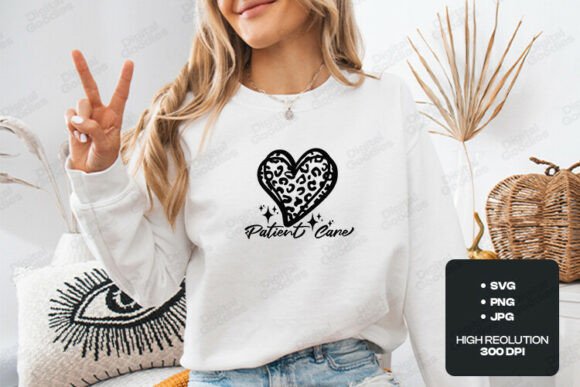
Patient Care Leopard Heart Design
First Impressions: Bold, Warm, and Unexpectedly Human
When I opened the Patient Care Leopard Heart Design, I didn’t see another “nurse appreciation” cliché—I saw personality. The leopard print heart isn’t loud or cartoonish; it’s grounded, slightly organic in its pattern flow, and balanced by clean, confident typography that reads as warm rather than clinical. It lands somewhere between boutique charm and professional sincerity—exactly where healthcare workers want to be seen. As a designer who’s stitched hundreds of themed pieces for clinics, baby showers, and caregiver gift sets, this one immediately sparked ideas: a soft cotton apron for a pediatric nurse, a linen tea towel for a therapist’s home office, or even a small embroidered patch sewn onto a lab coat lapel.
A Real-World Test: Stitching It on a Heavy Cotton Tote
Last week, I used the Patient Care Leopard Heart Design on a 14-oz natural canvas tote—intended for a local clinic’s volunteer appreciation day. I chose medium-weight cutaway stabilizer and tested three thread color combos (charcoal gray on cream, burgundy on oat, and navy on heather grey). The design held up beautifully: the leopard texture translated well through fill stitch without overloading density, and the lettering remained legible at 3.5" wide. No puckering, no skipped stitches—even across the subtle curve of the tote’s side seam. That tells me this isn’t just a T-Shirt Designs graphic repurposed for embroidery; it’s built with stitch logic in mind. It breathes. It adapts.
Where It Shines—and Where It Needs Thought
The Patient Care Leopard Heart Design excels on structured, mid-to-heavyweight fabrics: sweatshirt fleece, denim jackets, twill aprons, and pillow covers. Its visual weight holds up in both custom apparel and handmade product contexts—especially when paired with thoughtful finishing (like folded edge binding or contrast topstitching).
- Great for: Embroidered patches, tote bag design, sweatshirt embroidery, baby embroidery (on burp cloths or onesie pockets), holiday embroidery (think “Nurse Santa” stockings), and boutique branding for wellness shops.
- Use carefully on: Thin knits (like lightweight t-shirts), highly stretchy fabric (unless stabilized aggressively), curved surfaces like caps (lettering may distort), and dark fabric where fine leopard details could blur without high-contrast thread.
What This Design Says Before You Even Stitch It
Customers don’t just buy a heart—they buy meaning. And this design delivers it without leaning on tired symbols. The leopard print adds quiet confidence; the heart says care; the typography says “I see you.” That combination builds customer trust faster than generic script fonts or clip-art hearts. I’ve watched buyers pause longer over this design in Etsy mockups—not because it’s flashy, but because it feels *known*. It reads as handmade, intentional, and emotionally intelligent. For an Etsy seller or small shop product, that nuance translates directly into higher perceived value and stronger buyer engagement.
Practical Notes Every Embroidery Designer Should Check
Before adding the Patient Care Leopard Heart Design to your next commercial embroidery run or digital embroidery file bundle, here’s what I do—and recommend you do too:
- Test on scrap fabric first—especially if using textured or blended fabrics. Leopard patterns can shift subtly depending on stitch direction and tension.
- Review stitch density in your editing software. If it’s dense in the heart’s center, consider lightening fill stitch % by 5–8% for breathable fabrics.
- Confirm hoop size compatibility. This design works comfortably in a 4x4 hoop, but check whether your version includes alternate sizes for larger applications (e.g., 6x10 for tote front panels).
- Inspect small details—especially the serif ends on the word “Care.” They’re delicate but not fragile; still, avoid shrinking below 2.75" without checking clarity.
- Test black-and-white mockups alongside color versions. This design’s contrast holds up well, but grayscale previews help spot areas where leopard texture might fade on low-res listings.
- Compare light vs. dark fabric backgrounds. On charcoal, use cream or pale gold thread for the leopard; on ivory, deep rust or slate keeps it grounded—not cutesy.
- Use proper stabilizer. Cutaway for knits, tear-away for stable wovens, and fusible + cutaway for layered garments like reversible aprons.
- Verify licensing. Since this is marketed as a Graphics-type asset, confirm whether it permits resale of finished products *and* redistribution of the digital file—especially if you’re building a craft business or selling design assets.
Final Thought: Not Just a Design—A Conversation Starter
The Patient Care Leopard Heart Design doesn’t shout. It invites. When stitched onto a nurse’s scrub top or a caregiver’s kitchen towel, it sparks recognition—not just of profession, but of individuality. That’s rare in healthcare-themed embroidery. Too many designs lean hard into “hero” tropes or sterile minimalism. This one lands softly, confidently, and memorably. Whether you’re prepping for a craft fair, building an Etsy listing, or creating personalized gifts for hospice staff, it earns its place in your design assets library—not as filler, but as a go-to for authenticity.
If you’re evaluating it for your next embroidery project, ask yourself: Does it reflect the person wearing it—not just their job title? Does it hold up under real wear, real washing, and real attention? With the Patient Care Leopard Heart Design, the answer is yes—provided you treat it like the considered, human-centered machine embroidery design it is.